
Index fund investing beats most actively managed funds over time while charging a fraction of the fees. Here's how the math actually works and why a $500 monthly habit matters more than stock picking.
An index fund just buys every company in a market benchmark, like the S&P 500, instead of a manager picking winners. That structure is why fees run around 0.03% to 0.10% a year compared to 0.5% to 1.5% for actively managed funds — on a $100,000 account, that's the difference between paying $30 a year and paying $1,000. Lower fees aren't a nice bonus; they're the main reason index funds beat roughly 80-90% of actively managed funds over 10-15 year periods, according to S&P's own SPIVA scorecards.
The mechanism is simple math, not magic: a fund manager has to beat the market by more than their fee just to match an index fund's net return, and most don't do it consistently year after year. Say two people invest $10,000 for 30 years at a 9% average annual return. One pays 0.04% in fees, the other pays 1%. The low-fee investor ends up with about $127,000 more, just from that fee gap compounding over three decades.
The common mistake isn't picking the wrong index fund — most total market or S&P 500 funds are nearly interchangeable. It's panic-selling during a downturn, which locks in losses that would have recovered. The S&P 500 dropped 34% in early 2020 and fully recovered within five months; investors who sold in March and sat in cash missed the entire bounce.
Start with a total U.S. stock market index fund or an S&P 500 fund — Vanguard's VTSAX/VTI, Fidelity's FXAIX, or Schwab's SWTSX all work and charge next to nothing. Set up an automatic monthly transfer, even if it's $100, and leave it alone for a decade. The goal isn't to beat the market; it's to capture the market's return for almost free, which historically has still turned out to be about 10% a year before inflation.
Key Takeaways
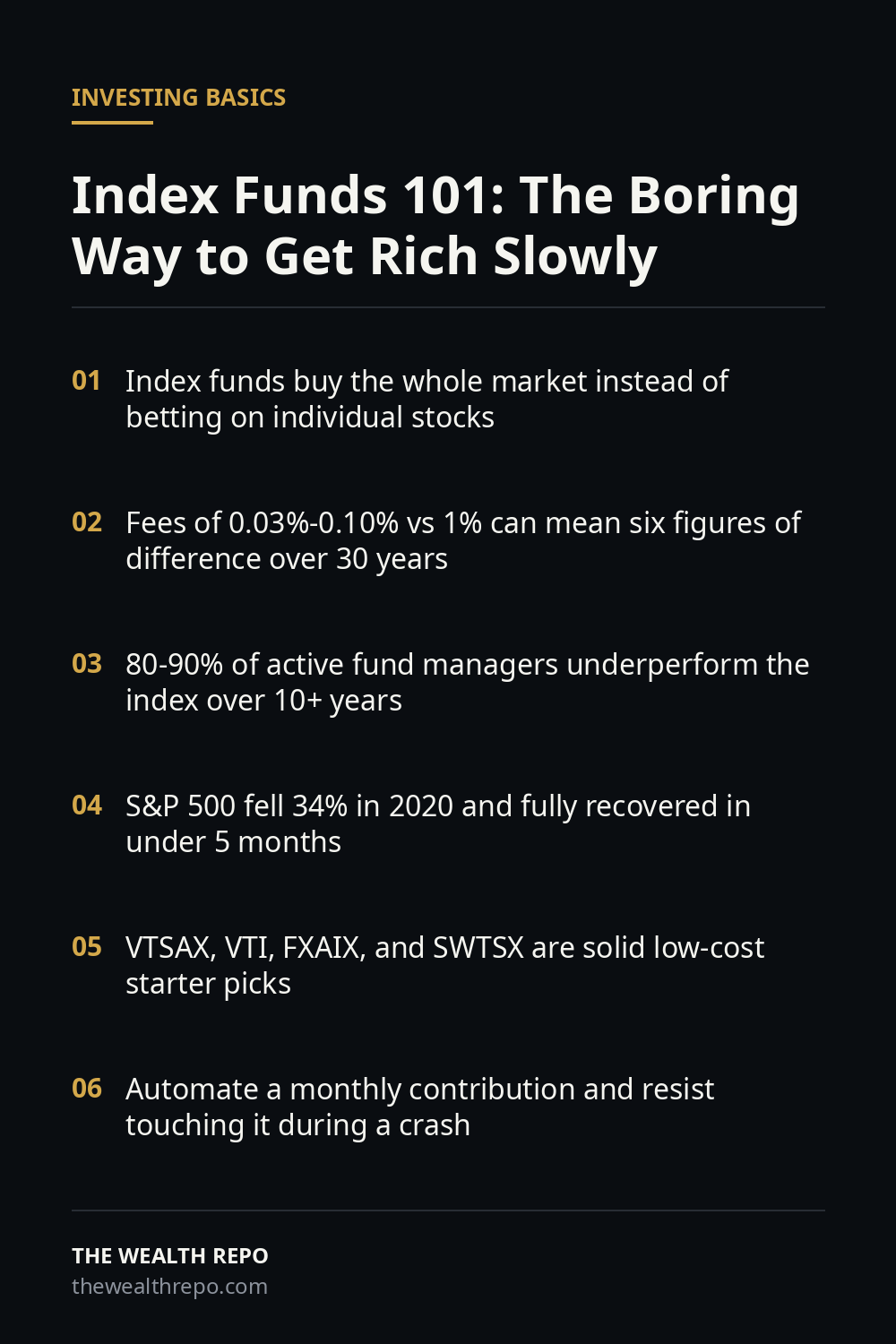
- ✅ Index funds buy the whole market instead of betting on individual stocks
- ✅ Fees of 0.03%-0.10% vs 1% can mean six figures of difference over 30 years
- ✅ 80-90% of active fund managers underperform the index over 10+ years
- ✅ S&P 500 fell 34% in 2020 and fully recovered in under 5 months
- ✅ VTSAX, VTI, FXAIX, and SWTSX are solid low-cost starter picks
- ✅ Automate a monthly contribution and resist touching it during a crash

