
Debt avalanche saves you more money in interest, but debt snowball keeps more people actually paying off their debt. Here's the real breakdown, with numbers, so you can pick the method that won't get abandoned in month three.
The debt avalanche method has you pay minimums on everything except the debt with the highest interest rate, which gets every spare dollar until it's gone. Mathematically, this is the correct answer every time, because interest is what's actually costing you money. Say you have a $3,000 card at 24% APR, a $6,000 card at 18%, and a $9,000 personal loan at 9%. Avalanche has you attack the $3,000 card first even though it's not your biggest balance, because that 24% is bleeding you faster than anything else.
The debt snowball flips the order: smallest balance first, regardless of interest rate. In the example above, you'd start with the $3,000 card too, since it happens to also be smallest, but if the numbers were reversed, snowball would send you after a low-interest debt while a 24% card sat untouched. That sounds financially wrong, and it is, on paper. Dave Ramsey popularized this method for one reason: knocking out a full balance in 60-90 days gives you a win you can see, and that win is what gets people to stick with the plan for the next 18 months.
Here's the actual cost of choosing wrong for you: on $18,000 of debt across three cards, avalanche might save you $400-$800 in total interest compared to snowball, depending on rate spread and payoff speed. That's real money, but it's not the $5,000 people assume. The bigger cost is quitting. If you pick avalanche, get demoralized because your first target debt is $9,000 and takes eight months to see progress on, and stop paying extra altogether, you've lost far more than $800 in interest.
The honest answer: run avalanche if your rate spread is wide, like a 24% card next to a 7% loan, because the interest savings there are large enough to matter and worth gritting your teeth through a slow first debt. Run snowball if your debts are within a few points of each other, or if you've tried a spreadsheet-driven payoff plan before and abandoned it by March. Either way, automate the minimum payments on everything else so a missed payment doesn't wreck your credit while you're focused on the target debt.
Key Takeaways
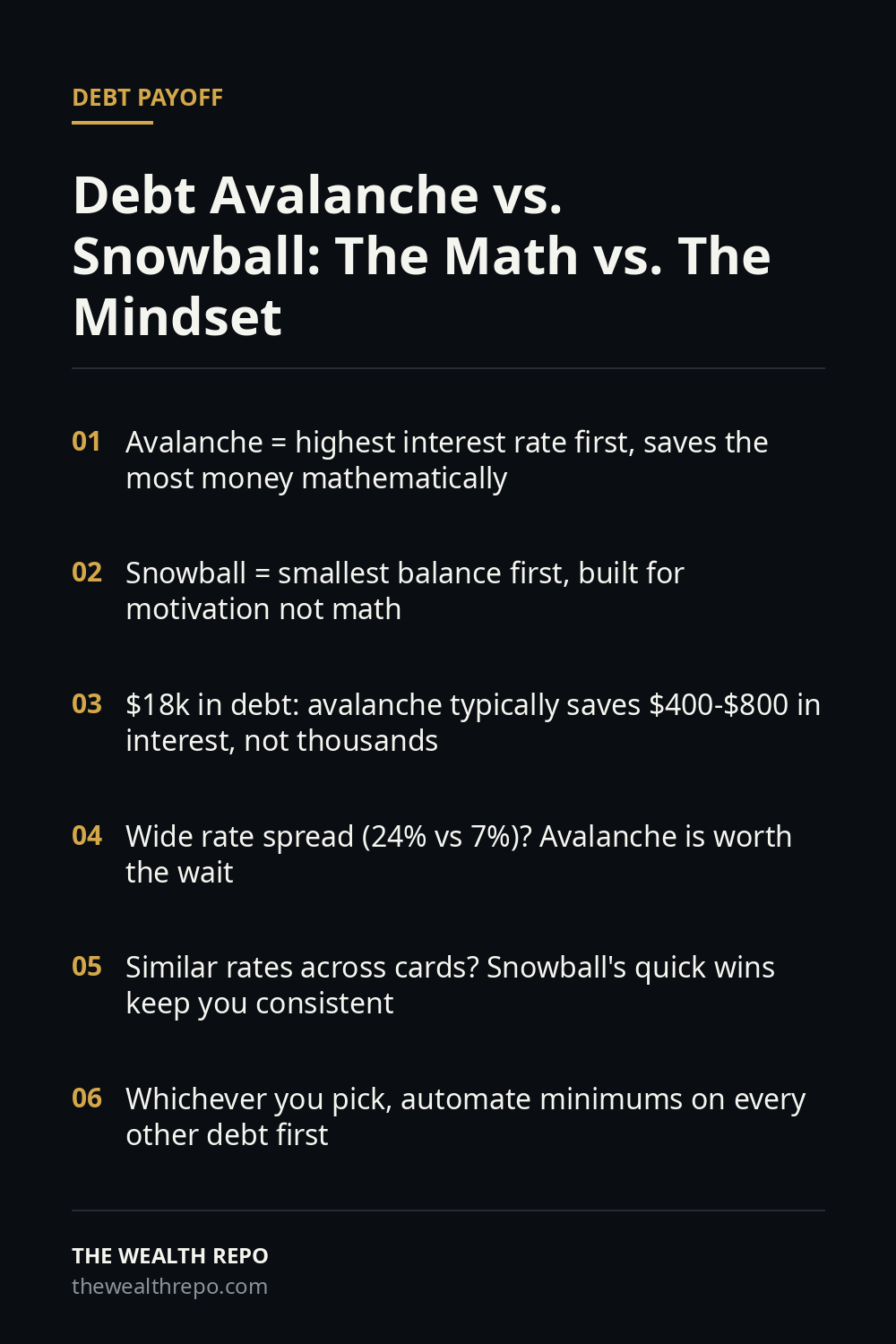
- ✅ Avalanche = highest interest rate first, saves the most money mathematically
- ✅ Snowball = smallest balance first, built for motivation not math
- ✅ $18k in debt: avalanche typically saves $400-$800 in interest, not thousands
- ✅ Wide rate spread (24% vs 7%)? Avalanche is worth the wait
- ✅ Similar rates across cards? Snowball's quick wins keep you consistent
- ✅ Whichever you pick, automate minimums on every other debt first

