
Your bank balance lies to you, but your net worth doesn't. Here's how to track it in 15 minutes a month and why the trend line matters more than the number itself.
Checking your bank balance feels productive, but it's mostly noise. A $4,200 balance the week after payday and $600 the week before it are the same financial life, just different snapshots. Net worth strips out that noise by measuring what you own minus what you owe, which is the only number that actually moves when you're making progress or losing ground.
The math is simple: add up your assets (cash, retirement accounts, home equity, car value) and subtract your liabilities (credit cards, student loans, mortgage balance, car loans). Someone with $80,000 in a 401k, $15,000 in savings, and a car worth $10,000, but $35,000 in student loans and $8,000 in credit card debt, has a net worth of $62,000. That single figure tells you more about their financial trajectory than their salary does.
The mistake most people make is checking it too often and reacting to normal noise. Stock markets move 1-2% in a week without meaning anything, and a $50,000 portfolio can swing $1,000 in either direction on a random Tuesday. Track it monthly, on the same day each month, and judge yourself on the 12-month trend, not the weekly wiggle. A line that's up 8% over the year matters; a dip from last Tuesday doesn't.
Use a free tool like Empower or a basic spreadsheet with two columns, assets and liabilities, updated once a month. The habit matters more than the tool. Someone who tracks a simple spreadsheet every month for three years will out-navigate their finances better than someone with a fancy app they open twice and abandon.
Key Takeaways
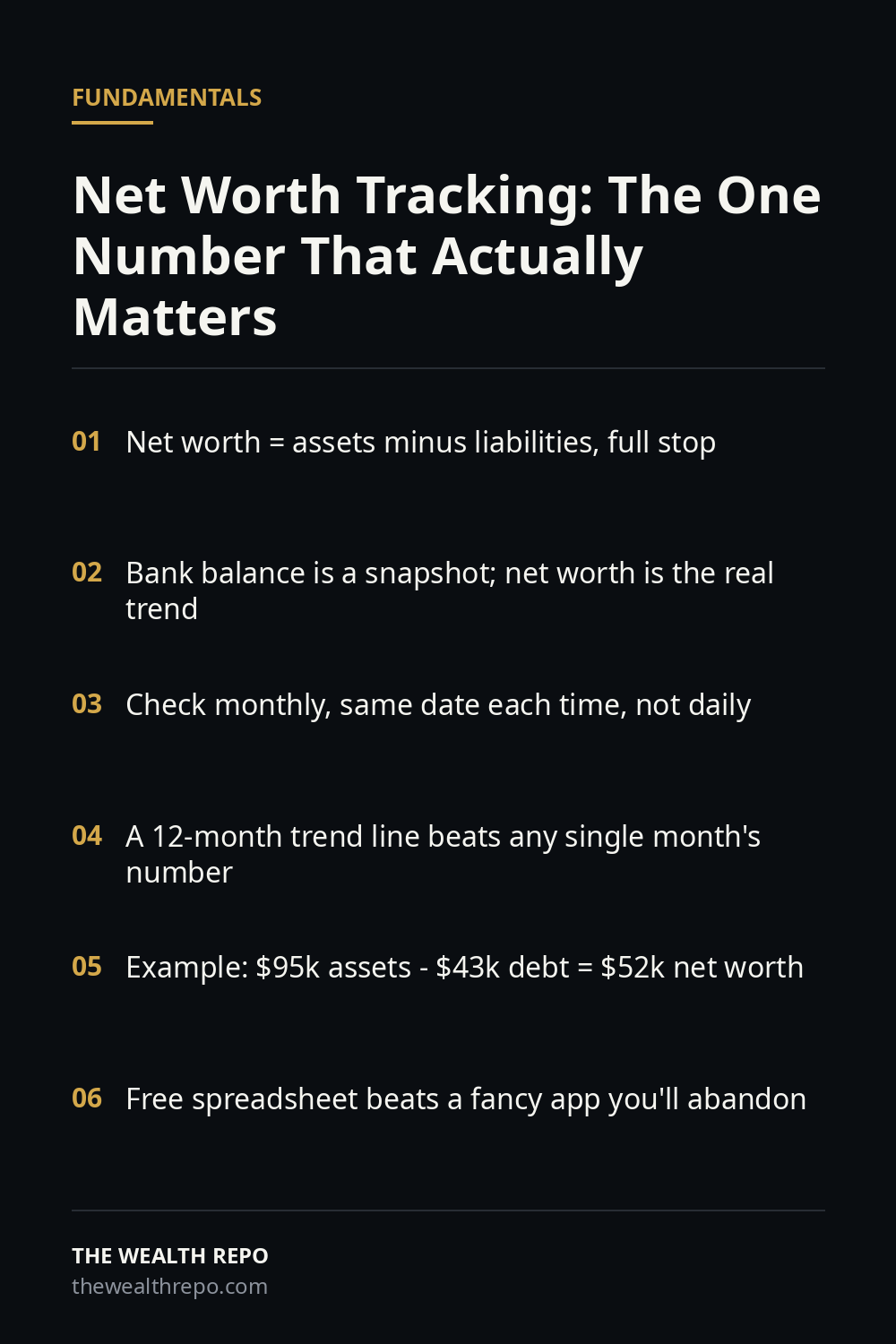
- ✅ Net worth = assets minus liabilities, full stop
- ✅ Bank balance is a snapshot; net worth is the real trend
- ✅ Check monthly, same date each time, not daily
- ✅ A 12-month trend line beats any single month's number
- ✅ Example: $95k assets - $43k debt = $52k net worth
- ✅ Free spreadsheet beats a fancy app you'll abandon

