
Starting five years earlier can outgrow investing twice as much money later. Here's the actual math on compound interest, including the mistake that costs most people six figures over a lifetime.
Compound interest works because your returns start earning their own returns, and the effect gets stronger the longer money sits untouched. Put $5,000 in an account earning 8% annually and after year one you have $5,400 — but by year twenty you're not adding $400 a year, you're adding over $2,000 a year, because you're earning 8% on a much bigger pile. The growth curve is flat for a while and then bends sharply upward, which is exactly why the early years feel pointless and the later years feel like magic.
Here's the number that should change how you think about waiting: an investor who puts in $200 a month from age 25 to 35 (just 10 years, $24,000 total) and then stops contributing but leaves it invested until 65, will end up with more money at 8% average returns than someone who starts at 35 and contributes $200 a month every year until 65 ($72,000 total). The first investor comes out ahead — around $340,000 versus $300,000 — despite contributing a third as much cash. Time in the market did more work than the size of the contributions.
The common mistake is treating 'I don't have enough to invest yet' as a valid reason to delay. You don't need $10,000 to start — most brokerages let you open an account with $0 and buy fractional shares of an index fund for $25. The cost of waiting isn't the money you didn't save, it's the compounding years you can never get back; a dollar invested at 25 is worth roughly 4-5 times more at retirement than a dollar invested at 45, assuming the same average return.
If you're in your 20s or 30s reading this with no investments open, the move is to open a Roth IRA or brokerage account this week and set up an automatic transfer of even $50 a month into a low-cost S&P 500 index fund. The amount matters far less right now than the act of starting, because you're not really investing $50 — you're buying 30-40 years of compounding for a small down payment.
Key Takeaways
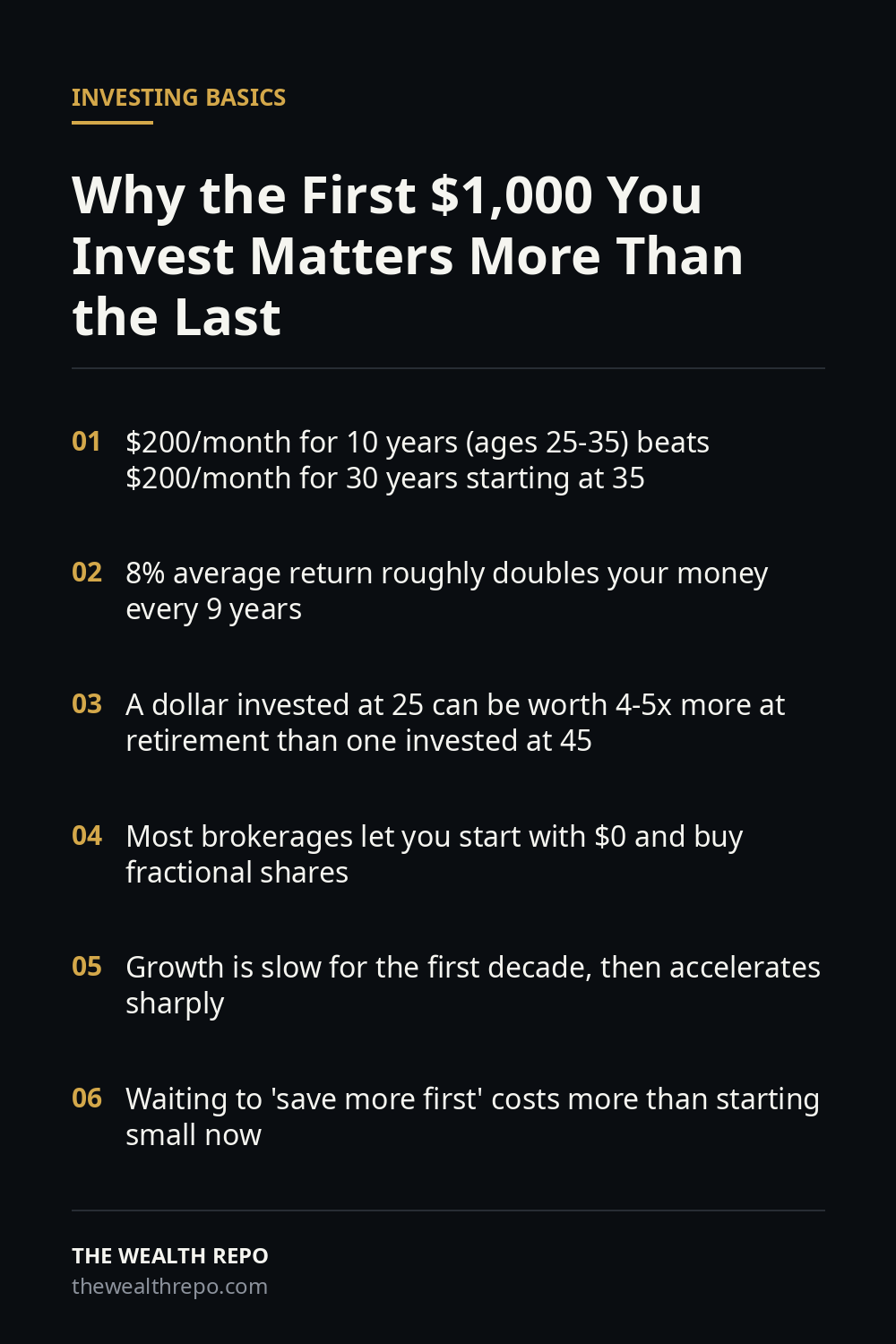
- ✅ $200/month for 10 years (ages 25-35) beats $200/month for 30 years starting at 35
- ✅ 8% average return roughly doubles your money every 9 years
- ✅ A dollar invested at 25 can be worth 4-5x more at retirement than one invested at 45
- ✅ Most brokerages let you start with $0 and buy fractional shares
- ✅ Growth is slow for the first decade, then accelerates sharply
- ✅ Waiting to 'save more first' costs more than starting small now

