
Disclosure: Some links on this page are affiliate links. If you sign up through them, The Wealth Repo may earn a commission at no extra cost to you. This is general education, not personalized financial advice.
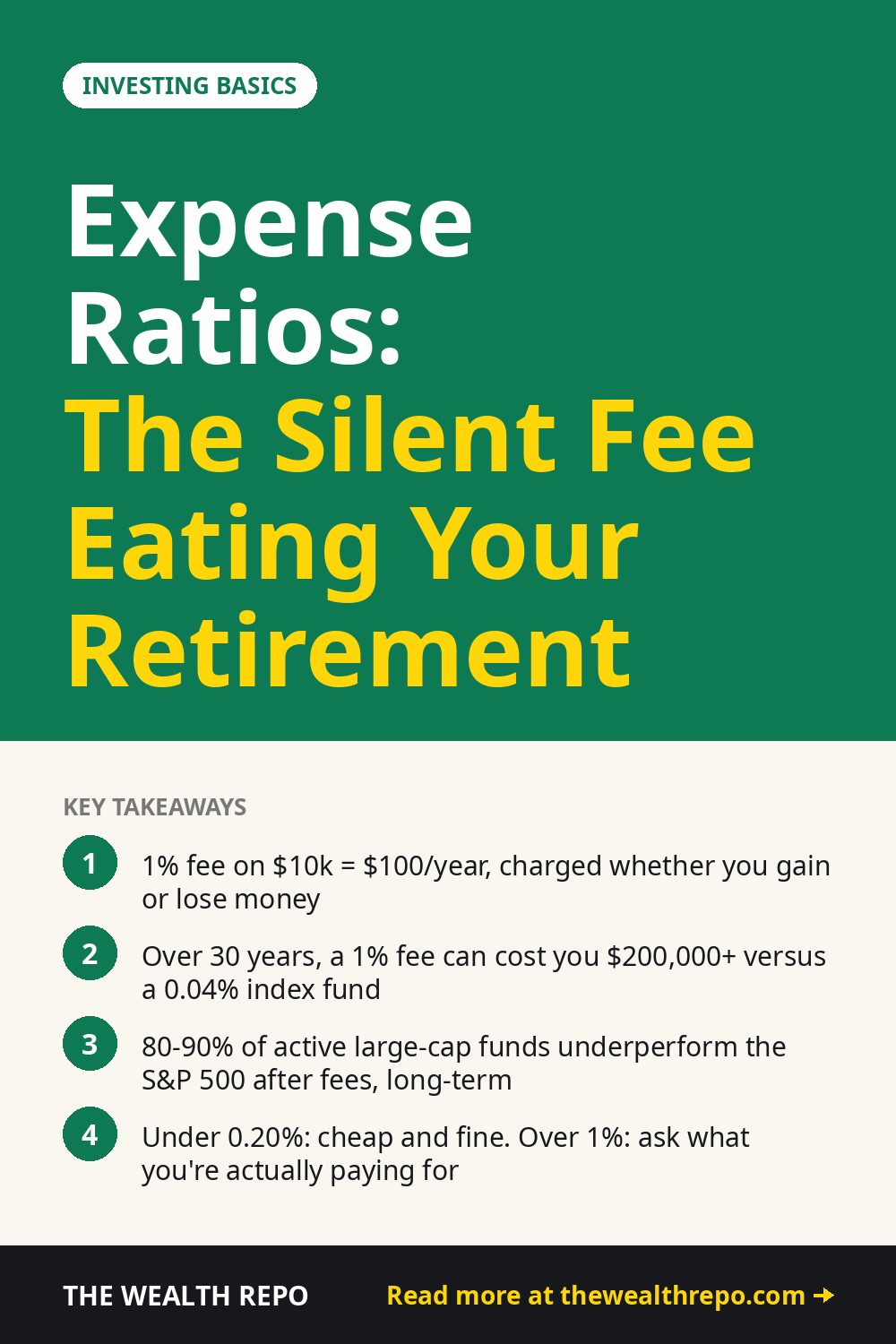
A 1% expense ratio sounds tiny, but it can cost you six figures over a career of investing. Here's the math on why low-cost index funds win, and which fee level should make you walk away.
Expense ratios are the annual fee a fund charges to manage your money, expressed as a percentage of your investment. A 1% expense ratio means you pay $100 a year for every $10,000 invested, and that fee comes out automatically whether the fund makes money or loses it. It sounds small next to a 10% market gain, which is exactly why so many people ignore it.
Here's the part that doesn't show up on your statement: that fee compounds against you the same way returns compound for you. Invest $10,000 a year for 30 years at an 8% average return, and a fund charging 0.04% (a typical S&P 500 index fund) grows to roughly $1.22 million. The same investment in a fund charging 1% grows to about $1.02 million. That 0.96 percentage point gap costs you $200,000, and the fund manager didn't have to beat the market or even match it to take that money — they just had to exist.
💡 The hardest part is opening the account. Robinhood lets you buy stocks and ETFs commission-free, with no account minimum. Open a Robinhood account →
The common mistake is assuming a higher fee buys better performance, since actively managed funds market themselves on the promise of beating the index. SPIVA data has shown for over a decade that roughly 80-90% of actively managed large-cap funds underperform the S&P 500 over any 10-15 year stretch, after fees. You're usually paying more for a worse outcome, not a better one — the fee doesn't buy skill, it buys a research team and a marketing budget.
A useful rule: anything under 0.20% is cheap and fine for a core index holding, 0.20%-0.50% needs a real reason (a specific sector or strategy you can't get elsewhere), and anything above 1% should make you check what you're actually getting. Check your 401(k) too — target-date funds and actively managed options inside employer plans routinely charge 0.5%-1.5%, and most people never look. Pull your plan's fund lineup and compare expense ratios side by side; swapping a 0.9% fund for a 0.05% index alternative with similar holdings is often the single highest-value five minutes you'll spend on your finances this year.
Key Takeaways
- ✅ 1% fee on $10k = $100/year, charged whether you gain or lose money
- ✅ Over 30 years, a 1% fee can cost you $200,000+ versus a 0.04% index fund
- ✅ 80-90% of active large-cap funds underperform the S&P 500 after fees, long-term
- ✅ Under 0.20%: cheap and fine. Over 1%: ask what you're actually paying for
- ✅ 401(k) target-date funds often hide 0.5%-1.5% fees — check your plan today
- ✅ Fees compound against you exactly like returns compound for you

