
Disclosure: Some links on this page are affiliate links. If you sign up through them, The Wealth Repo may earn a commission at no extra cost to you. This is general education, not personalized financial advice.
The old rule of thumb for stocks vs. bonds is too conservative for anyone retiring after 2000. Here's a sharper way to split your portfolio based on age, risk tolerance, and how long your money actually needs to last.
The classic formula — subtract your age from 100 to get your stock percentage — was built in an era when people retired at 65 and died at 72. A 30-year-old following it would hold 70% stocks, which sounds aggressive until you realize that same person has 35+ years before they touch the money. Most retirement planners now use 110 or even 120 minus age, because people are living into their 90s and need growth to outlast a 25-30 year retirement, not just a 10-year one.
Risk tolerance isn't just a feelings quiz, it's a math problem about how much of a drop you can survive without selling. If a 40% portfolio decline would force you to sell at the bottom to cover bills, you're overallocated to stocks regardless of what a questionnaire says. A concrete test: look at 2008, when the S&P 500 fell 37%. If that number makes your stomach drop and you'd have panic-sold, your real risk tolerance is lower than your age-based formula suggests, and you should shift 10-15% into bonds no matter what the calculator says.
💡 The hardest part is opening the account. Robinhood lets you buy stocks and ETFs commission-free, with no account minimum. Open a Robinhood account →
The common mistake is treating allocation as a one-time decision instead of something tied to a specific timeline. A 55-year-old with a pension and no plans to touch their 401(k) for 15 years can stay at 70% stocks. A 55-year-old retiring next year with that money as their only income source needs to be closer to 40-50% stocks, because a market drop the year you start withdrawals can permanently shrink what you have left — this is called sequence-of-returns risk, and it's done more damage to early retirees than any single bad investment pick.
Target-date funds handle this automatically by sliding your allocation from aggressive to conservative as you approach the target year, and for most people they're a reasonable default. But they assume you retire at 65 and have average risk tolerance, which doesn't fit everyone — if you're planning to retire at 50 or work until 70, a target-date 2040 fund is solving for the wrong year. Check the fund's glide path (its stock-to-bond ratio by year) against your actual retirement date before assuming it matches your situation.
Key Takeaways
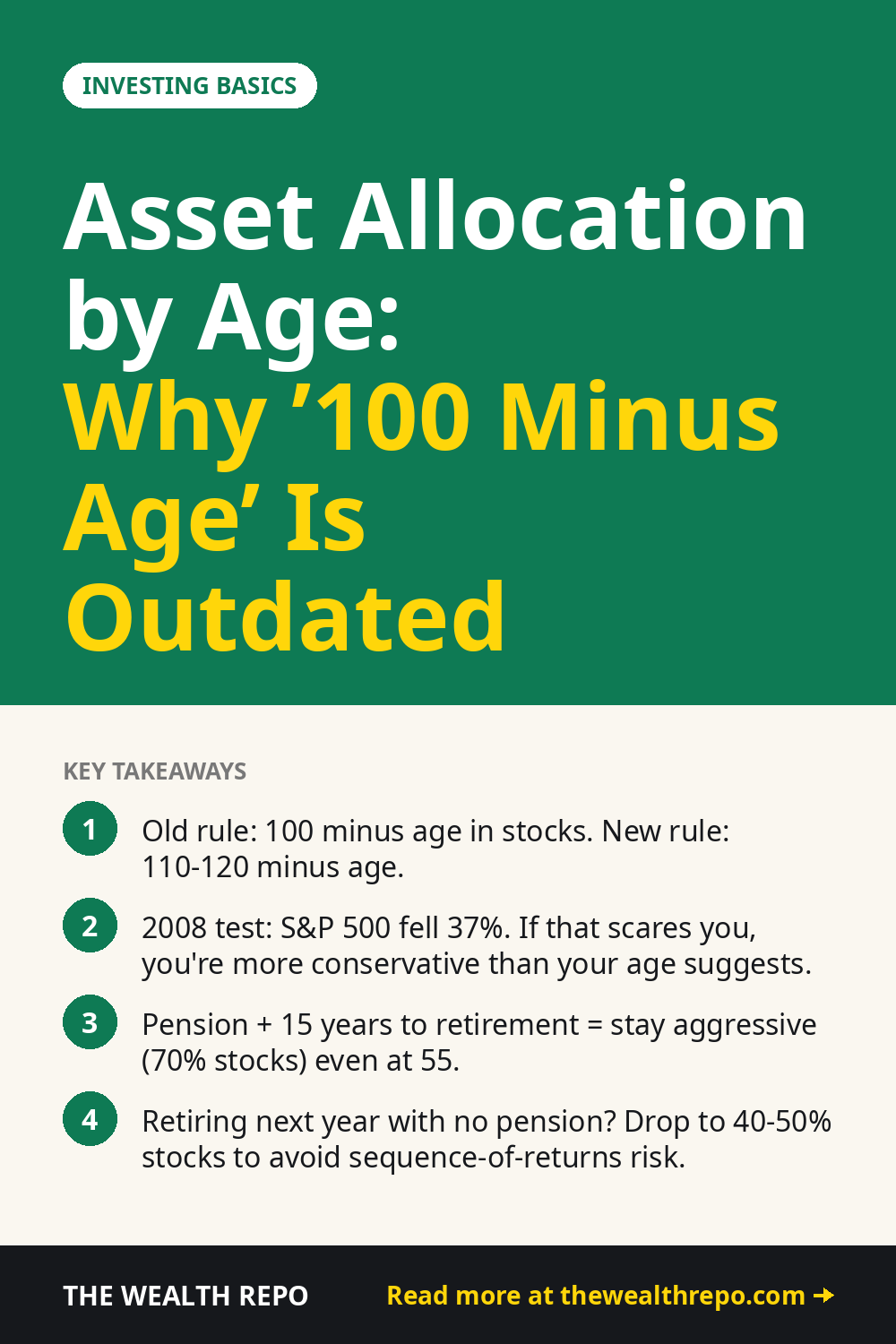
- ✅ Old rule: 100 minus age in stocks. New rule: 110-120 minus age.
- ✅ 2008 test: S&P 500 fell 37%. If that scares you, you're more conservative than your age suggests.
- ✅ Pension + 15 years to retirement = stay aggressive (70% stocks) even at 55.
- ✅ Retiring next year with no pension? Drop to 40-50% stocks to avoid sequence-of-returns risk.
- ✅ Target-date funds assume retirement at 65 — check the glide path if your plan is different.
- ✅ Risk tolerance = what you can survive without selling, not what a quiz says you feel.