
The 50/30/20 budget splits your after-tax income into needs, wants, and savings, but the ratios break down fast in high-cost cities. Here's how to adjust the math so it actually works for your paycheck.
The 50/30/20 rule says 50% of your take-home pay goes to needs, 30% to wants, and 20% to savings and debt payoff. Elizabeth Warren popularized it in her book 'All Your Worth,' and the appeal is obvious: three buckets, no spreadsheet, no 47-category budget app. On a $5,000 monthly take-home paycheck, that's $2,500 for rent and groceries, $1,500 for eating out and hobbies, and $1,000 toward savings or debt.
The problem shows up the moment rent alone eats 45-50% of your paycheck, which is reality in cities like San Francisco, Boston, or New York. If your rent is $2,200 on a $5,000 income, you've already blown the needs category before adding groceries, utilities, insurance, or a car payment. People in this spot often conclude the rule is broken and give up on budgeting entirely, when the fix is just re-slicing the percentages, not abandoning the structure.
A better version for high-cost earners: flip to 60/20/20 or even 65/15/20, keeping savings at 20% non-negotiable and shrinking the wants category instead of the needs one. The 20% savings target is the piece worth protecting, because that's what builds your emergency fund and retirement balance. Someone making $70,000 who saves 20% consistently from age 25 will out-save someone who saves whatever's left over, even if that second person technically earns more later.
One common mistake is counting debt minimums as 'needs' and extra debt payments as 'savings,' which inflates how good your ratio looks without actually moving the needle. A $300 credit card minimum is a need; the extra $200 you throw at it is really a debt-payoff line that belongs in the savings bucket math. Track it that way and the 20% number tells you the truth about whether you're actually getting ahead.
Key Takeaways
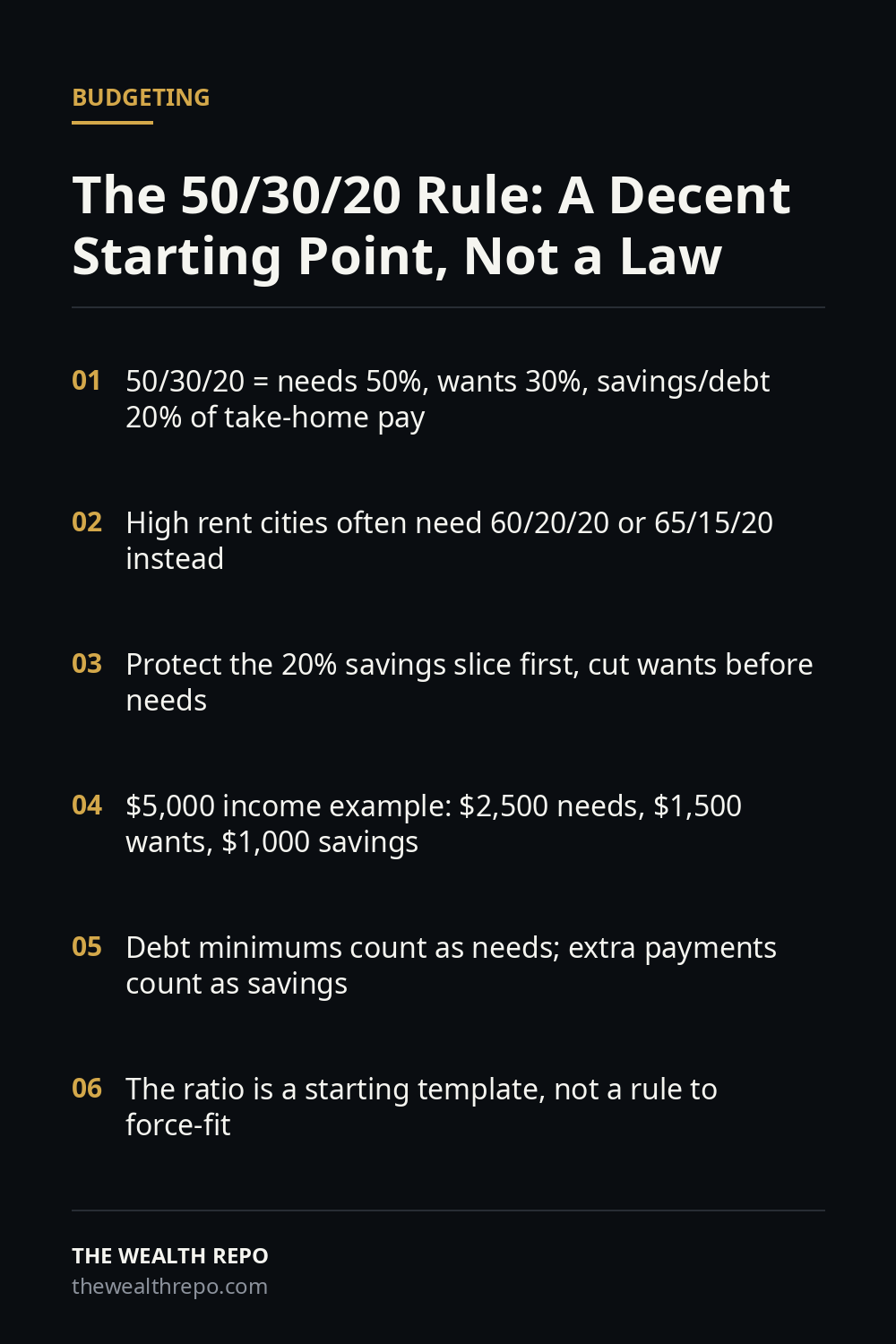
- ✅ 50/30/20 = needs 50%, wants 30%, savings/debt 20% of take-home pay
- ✅ High rent cities often need 60/20/20 or 65/15/20 instead
- ✅ Protect the 20% savings slice first, cut wants before needs
- ✅ $5,000 income example: $2,500 needs, $1,500 wants, $1,000 savings
- ✅ Debt minimums count as needs; extra payments count as savings
- ✅ The ratio is a starting template, not a rule to force-fit

