
Disclosure: Some links on this page are affiliate links. If you sign up through them, The Wealth Repo may earn a commission at no extra cost to you. This is general education, not personalized financial advice.
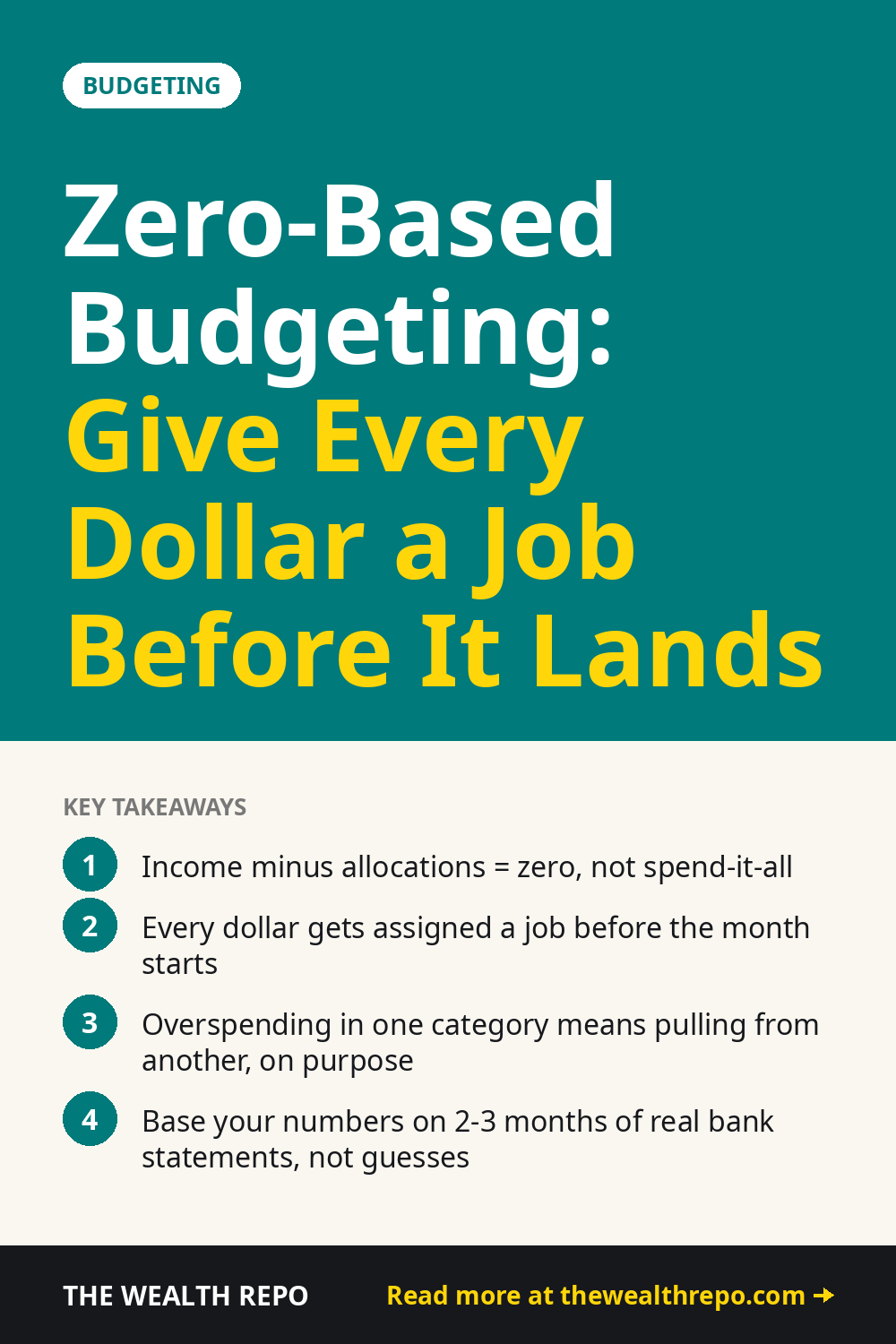
Zero-based budgeting forces you to assign every dollar of income to a category before the month starts, which closes the gap where impulse spending hides. Here's how to set one up in under 30 minutes and avoid the one mistake that sinks most attempts.
Zero-based budgeting means your income minus your allocations equals zero, not that you spend everything you earn. If you bring home $4,200 a month, you assign all $4,200 to specific jobs: $1,400 to rent, $500 to groceries, $300 to a car fund, $600 to debt payoff, $400 to retirement, and so on, until the last dollar has a label. The point isn't restriction, it's that nothing is left 'unassigned,' because unassigned money is exactly what gets spent on takeout and random Amazon orders by the 25th.
The mechanism that makes this work is friction. A regular budget tells you what you spent last month; a zero-based budget makes you decide in advance what this month's money is for, so when an impulse buy shows up, you have to actively steal from another category to pay for it. That small act of moving $40 out of 'clothing' into 'eating out' makes the tradeoff visible in a way that swiping a credit card never does. Most people don't overspend because they're bad with money — they overspend because nothing ever forces the tradeoff into view.
💡 Once the budget leaves room to save, give that money a job. Robinhood lets you buy stocks and ETFs commission-free, with no account minimum. Open a Robinhood account →
The common mistake is building a budget around who you wish you were instead of your actual spending history. People allocate $150 to groceries because it sounds responsible, blow through it by day twelve, and quit the whole system by month two. Pull your last two or three months of bank statements first, see what you actually spent in each category, and build your zero-based budget from that baseline — then adjust categories down by 5-10% at a time, not 50%, if you're trying to cut.
Irregular expenses are where zero-based budgets usually break, so build sinking funds for them instead of treating them as surprises. If car insurance is $600 every six months, that's $100 a month sitting in its own category whether you need it this month or not. Do this for annual subscriptions, holiday spending, and car repairs, and you stop the 'emergency' expenses that aren't actually emergencies — they're just predictable costs you didn't budget monthly.
Key Takeaways
- ✅ Income minus allocations = zero, not spend-it-all
- ✅ Every dollar gets assigned a job before the month starts
- ✅ Overspending in one category means pulling from another, on purpose
- ✅ Base your numbers on 2-3 months of real bank statements, not guesses
- ✅ Cut categories by 5-10% at a time, not in half, to avoid quitting
- ✅ Build sinking funds for irregular costs like insurance and repairs