
Disclosure: Some links on this page are affiliate links. If you sign up through them, The Wealth Repo may earn a commission at no extra cost to you. This is general education, not personalized financial advice.
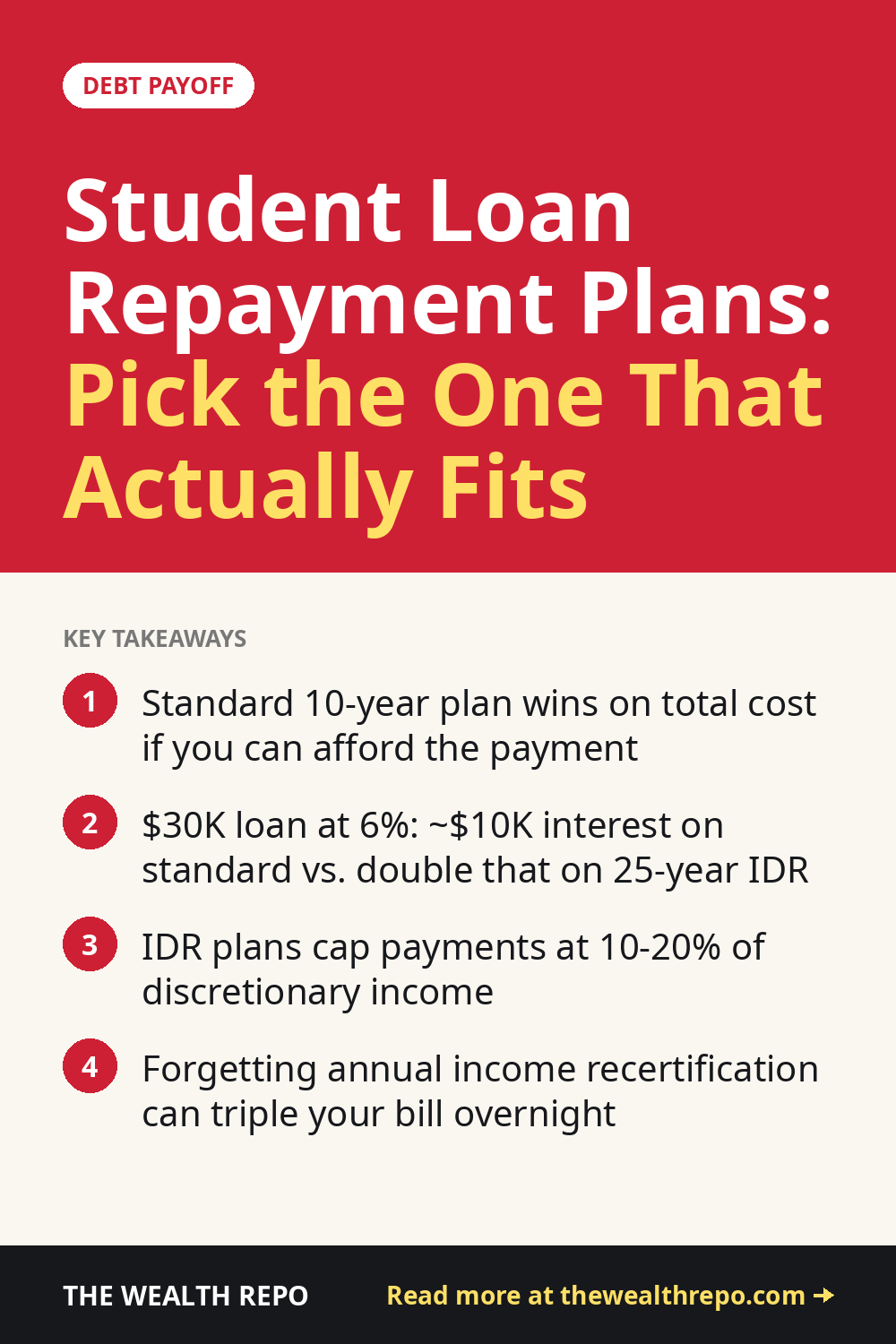
Income-driven plans sound like a safety net, but they can cost you tens of thousands more in interest if you don't need one. Here's how to pick the right plan based on your actual income and loan balance, not fear.
Most borrowers default into whatever plan their servicer picks for them, which is usually the Standard 10-Year Plan. That's actually the right call for anyone whose income covers the payment without wrecking their budget, because it's the only plan guaranteed to pay off your loans on a fixed timeline with the least total interest. The math is simple: on $30,000 at 6% interest, the standard plan costs about $10,000 in interest over 10 years. Stretch that same loan to 20 or 25 years under an income-driven plan and you can easily double the interest paid, even with a lower monthly bill.
Income-driven repayment (IDR) plans like SAVE, PAYE, and IBR cap your payment at a percentage of your discretionary income, usually 10-20%, and forgive the remaining balance after 20-25 years. These make sense in one specific scenario: your income is genuinely too low relative to your debt to afford the standard payment, say a $70,000 loan balance against a $45,000 salary. In that case an IDR plan isn't a trick, it's the only way to avoid default while your income grows into the debt. But if you're a $90,000 earner with $35,000 in loans just trying to save on interest, an IDR plan works against you.
💡 Once a debt is gone, keep making that payment, just to yourself. Robinhood lets you buy stocks and ETFs commission-free, with no account minimum. Open a Robinhood account →
The mistake that trips up the most borrowers isn't picking the wrong plan, it's forgetting to recertify income every year. Miss that deadline and your servicer defaults you to whatever the standard payment would be based on your original loan amount, sometimes tripling your monthly bill overnight with zero warning. Set a calendar reminder for 60 days before your recertification date, not the deadline itself, because servicer processing delays are common and a late submission can cost you a full payment cycle at the higher rate.
Public Service Loan Forgiveness changes the calculus entirely. If you work for a government agency or 501(c)(3) nonprofit, pairing an IDR plan with PSLF means your monthly payments are capped low for 10 years and the remaining balance is forgiven tax-free, not taxed as income like standard IDR forgiveness. Someone making $55,000 a year with $80,000 in loans could pay roughly $300/month for 10 years and have the rest wiped out, versus paying the loan off in full under a standard plan. Check your employer certification form every single year through the PSLF Help Tool, because missed certifications are the number one reason borrowers get denied after a decade of payments.
Key Takeaways
- ✅ Standard 10-year plan wins on total cost if you can afford the payment
- ✅ $30K loan at 6%: ~$10K interest on standard vs. double that on 25-year IDR
- ✅ IDR plans cap payments at 10-20% of discretionary income
- ✅ Forgetting annual income recertification can triple your bill overnight
- ✅ PSLF + IDR forgives remaining balance tax-free after 10 years in qualifying jobs
- ✅ Set recertification reminders 60 days early to avoid processing delays

