
Disclosure: Some links on this page are affiliate links. If you sign up through them, The Wealth Repo may earn a commission at no extra cost to you. This is general education, not personalized financial advice.
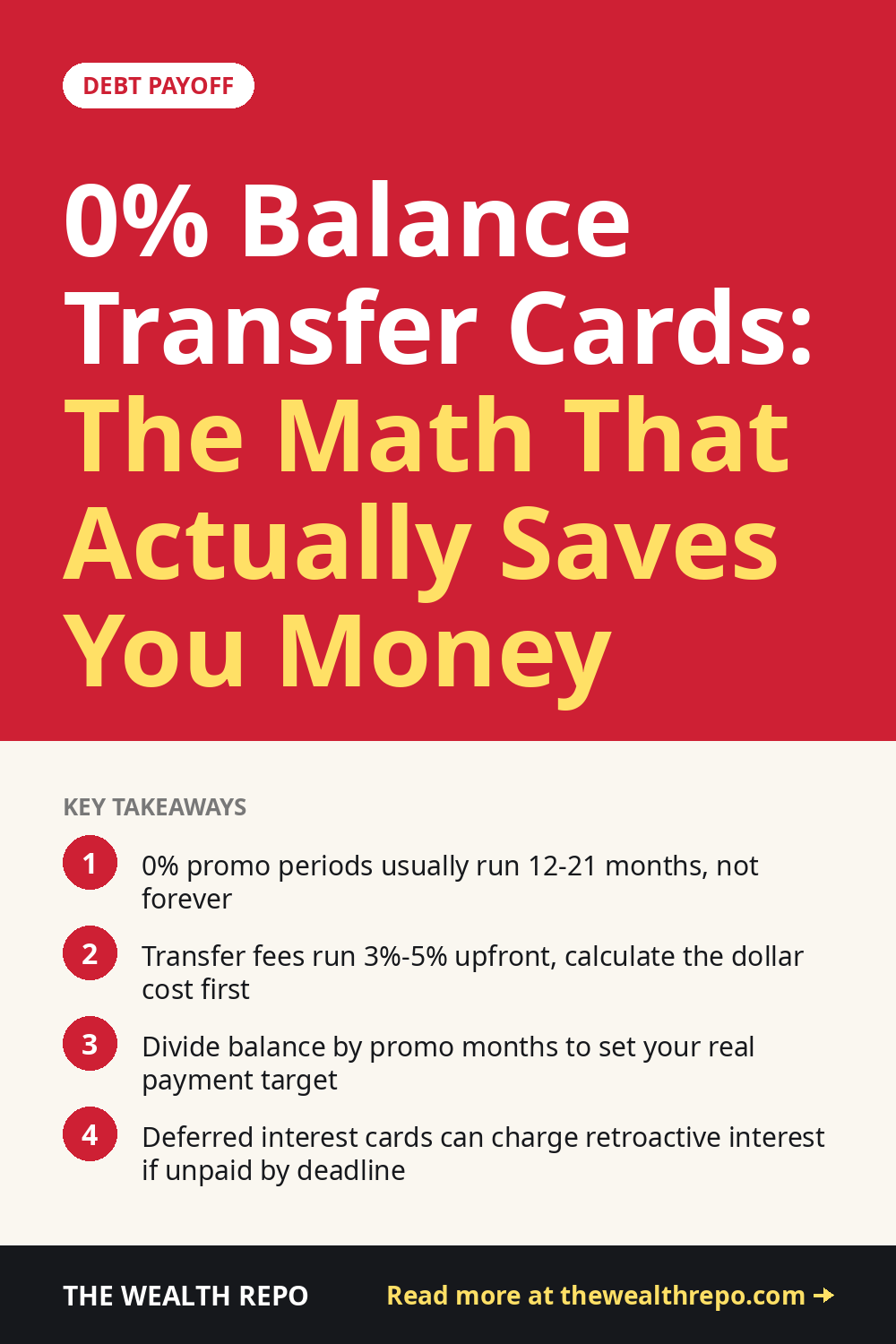
0% balance transfer cards can wipe out hundreds in interest, but only if you do the math before applying. Here's how the fees, timelines, and penalty traps actually work.
A balance transfer card moves your existing credit card debt onto a new card that charges 0% interest for a set window, usually 12 to 21 months. The catch is a transfer fee, typically 3% to 5% of the amount you move. Say you shift $8,000 at a 4% fee: that's $320 upfront, but if your old card was charging 24% APR, you'd have paid roughly $1,900 in interest over 15 months instead. The fee is a known, fixed cost. The interest you're avoiding is the real number that matters.
The most common mistake isn't picking the wrong card, it's doing nothing with the breathing room. People transfer $6,000, watch the 0% clock start, and keep paying the same $150 minimum they always did. At that rate you'll clear maybe $2,250 before the promo period ends, leaving thousands to revert to a 22%+ APR. Divide your balance by the number of promo months and pay that amount instead, so an $8,000 balance on an 18-month offer means $445 a month, not whatever the minimum says.
💡 Once a debt is gone, keep making that payment, just to yourself. Robinhood lets you buy stocks and ETFs commission-free, with no account minimum. Open a Robinhood account →
Watch the deferred interest trap on some store and retail cards, which is different from a true 0% balance transfer card. With deferred interest, if you don't pay the entire balance off by the deadline, you owe interest retroactively on the full original amount, not just what's left. A true balance transfer card only charges interest going forward on the remaining balance, so confirm which type you're holding before you relax.
One more detail people skip: a single late payment can void the 0% rate immediately under the card's penalty APR terms, sometimes jumping to 29.99% overnight. Set up autopay for at least the minimum the day you open the account, then add manual extra payments on top. And don't close your old card right after transferring the balance, since that can shrink your available credit and hurt your utilization ratio before the new debt is even paid off.
Key Takeaways
- ✅ 0% promo periods usually run 12-21 months, not forever
- ✅ Transfer fees run 3%-5% upfront, calculate the dollar cost first
- ✅ Divide balance by promo months to set your real payment target
- ✅ Deferred interest cards can charge retroactive interest if unpaid by deadline
- ✅ One missed payment can trigger a penalty APR near 30%
- ✅ Keep the old card open after transferring to protect your credit utilization

