
Disclosure: Some links on this page are affiliate links. If you sign up through them, The Wealth Repo may earn a commission at no extra cost to you. This is general education, not personalized financial advice.
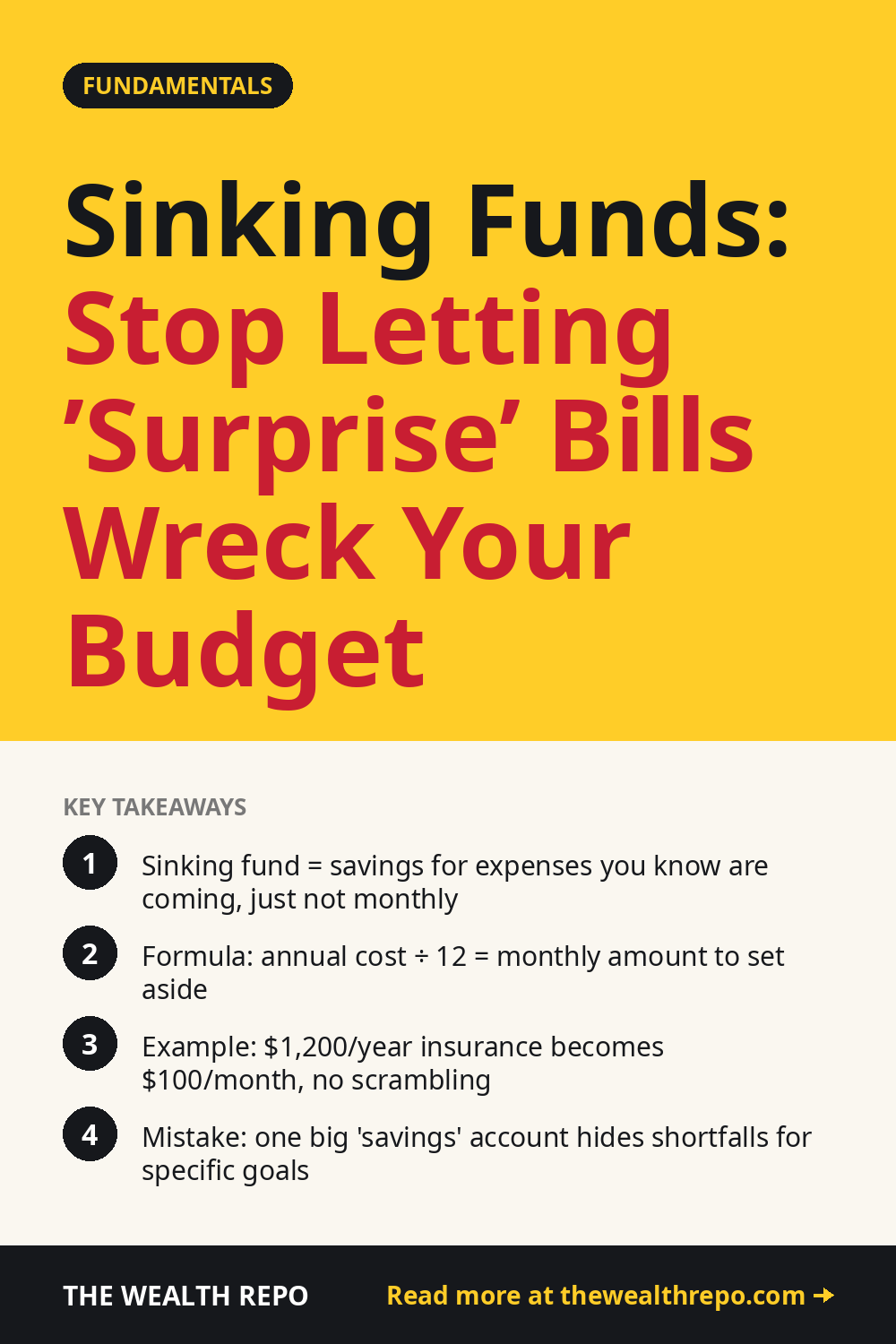
Car registration, holiday gifts, and annual insurance premiums aren't surprises — they're predictable costs you can prepare for with a sinking fund. Here's how to set one up in under 20 minutes and never raid your emergency fund again.
A sinking fund is a separate pot of money you build up gradually for a specific, expected expense that doesn't come monthly. Think car repairs, annual insurance premiums, holiday spending, or that $400 HVAC tune-up every spring. The mechanism is simple: you take the total annual cost, divide by 12, and move that amount into a dedicated savings bucket every month so the money is already there when the bill shows up.
Here's a concrete example. Say your car insurance is billed twice a year at $600 a pop, totaling $1,200 annually. Instead of scrambling to cover it twice a year, you set aside $100 a month in a sinking fund labeled 'car insurance.' When the bill arrives, you're not dipping into your checking account buffer or putting it on a credit card — you're just transferring money you already saved on purpose.
💡 The money you free up does the most good once it's working for you. Robinhood lets you buy stocks and ETFs commission-free, with no account minimum. Open a Robinhood account →
The common mistake is lumping all these expenses into one generic 'savings' account, which makes it impossible to tell if you're actually on track for each one. If you've got $2,000 sitting in savings but you owe $1,800 in property taxes next month and also need $600 for a holiday trip, you're not covered — you're $400 short and didn't know it until the bill hit. Separate funds, even if they're just labeled lines in a budgeting app or sub-accounts at an online bank, keep each goal visible and funded on its own.
People often object that sinking funds feel like extra admin for money that's 'already budgeted.' But the real value is psychological: it turns an annual $1,200 expense into a $100 monthly non-event instead of a panic-inducing lump sum. Open a free sub-account at an online bank like Ally or Capital One 360, name it after the expense, and automate a transfer the day after each paycheck.
Key Takeaways
- ✅ Sinking fund = savings for expenses you know are coming, just not monthly
- ✅ Formula: annual cost ÷ 12 = monthly amount to set aside
- ✅ Example: $1,200/year insurance becomes $100/month, no scrambling
- ✅ Mistake: one big 'savings' account hides shortfalls for specific goals
- ✅ Use labeled sub-accounts, not mental math, to track each fund
- ✅ Automate transfers right after payday so funding happens without thinking

