
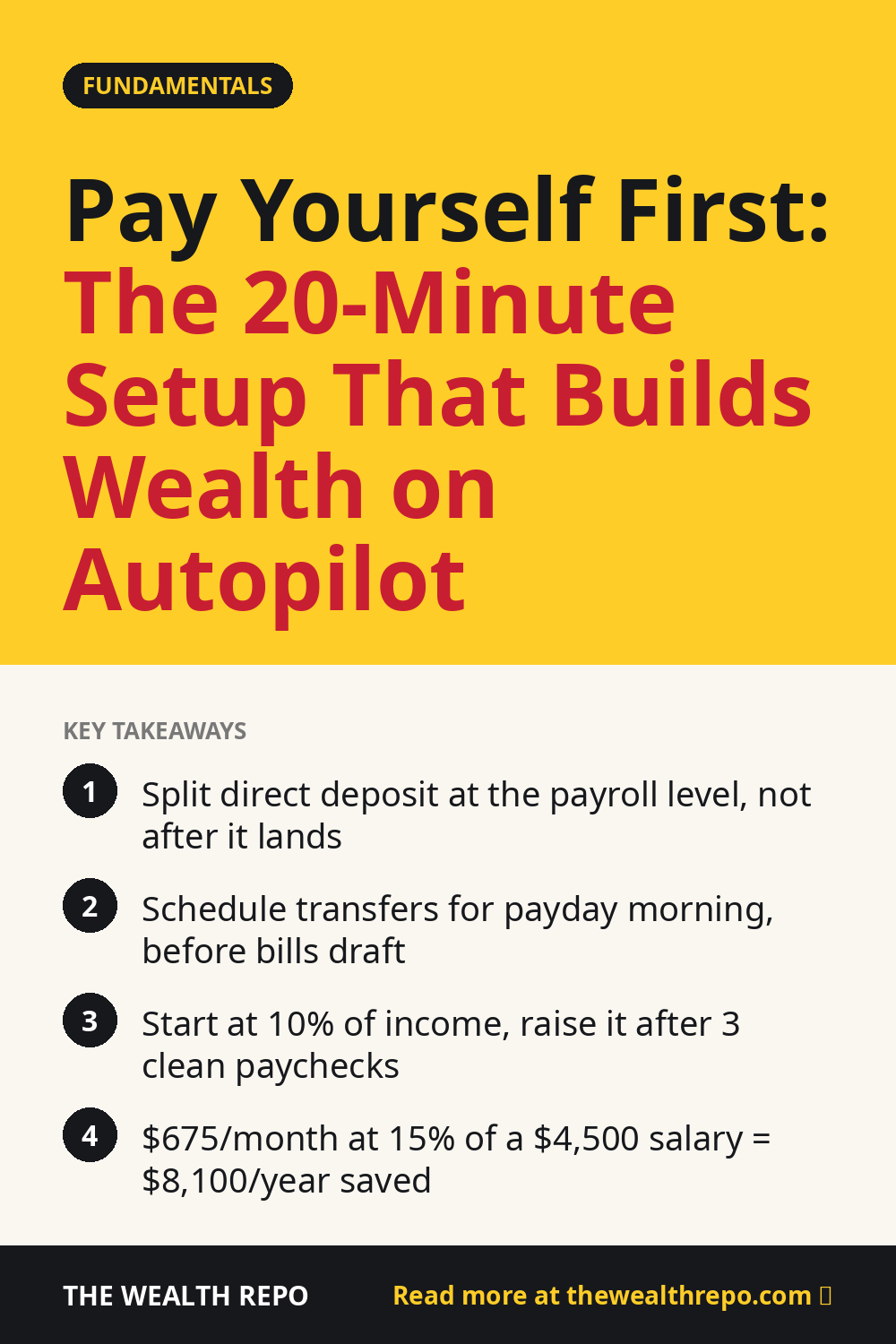
Pay-yourself-first automation moves savings out of your checking account before you ever see it, so you stop relying on willpower. Here's the exact account setup and split that makes it stick.
The reason budgeting apps fail most people isn't the app — it's the order of operations. If money lands in checking and savings happens 'whenever there's extra,' there's never extra. Pay yourself first flips the sequence: the moment your paycheck hits, a fixed chunk leaves before you can spend it, and you build your spending life around what's left, not the other way around.
The mechanism is direct deposit splitting or an automatic transfer scheduled for the same day your pay arrives. Most employers let you split direct deposit across two or three accounts right on the payroll form — say 70% to checking, 20% to a high-yield savings account, 10% to a retirement or brokerage account. If your employer only allows one account, set a bank transfer to fire the morning after payday, before bills auto-draft, so the money is gone before it can get spent on something else.
Concrete example: someone earning $4,500 a month who automates 15% off the top saves $675 before ever opening their banking app. Over a year that's $8,100, compounding in an index fund at 7% turns into roughly $115,000 over 20 years from that single habit, with zero additional decisions required after setup. Compare that to 'I'll save what's left' — the average person who tries that saves closer to 2-4% of income, because checking account balances have a way of finding something to spend themselves on.
The common mistake is automating an amount that's too aggressive, which causes overdrafts, which causes people to kill the whole system within two months. Start at 10%, let it run for three paychecks, and only increase it once you've confirmed bills still clear comfortably. The goal is a transfer you forget about, not one you have to defend every month.
Key Takeaways
- ✅ Split direct deposit at the payroll level, not after it lands
- ✅ Schedule transfers for payday morning, before bills draft
- ✅ Start at 10% of income, raise it after 3 clean paychecks
- ✅ $675/month at 15% of a $4,500 salary = $8,100/year saved
- ✅ 7% growth turns that into ~$115K over 20 years, untouched
- ✅ Self-directed savers average 2-4%; automated savers average 10%+

