
The 4% rule turns your annual spending into a concrete savings target, not a vague retirement dream. Here's how to calculate your FIRE number correctly and where the rule actually breaks down.
Your FIRE number is just your annual spending multiplied by 25. Spend $40,000 a year and your number is $1,000,000. That multiplier comes directly from the 4% rule: withdraw 4% of your portfolio in year one, adjust that dollar amount for inflation every year after, and a portfolio of roughly 60-75% stocks has historically lasted at least 30 years without running dry.
The 4% figure comes from the Trinity Study, which tested historical market returns from 1926 onward and found that a 4% starting withdrawal rate survived every 30-year period, including rough stretches like the 1970s. People misread this as 'you can spend 4% of your balance every year,' which is wrong — you lock in the dollar amount in year one and inflate it annually regardless of what the market does. If you retire with $1,000,000, you take $40,000 that first year; if inflation runs 3%, year two's withdrawal is $41,200, even if your portfolio dropped to $900,000.
The biggest mistake is using your current salary or gross income instead of actual spending. Someone earning $90,000 but spending $55,000 after taxes, 401(k) contributions, and a mortgage that'll be paid off by retirement has a FIRE number near $1,375,000, not $2,250,000. Track your real post-retirement expenses for a few months — strip out savings contributions, commuting costs, and work clothes, but add back healthcare premiums you won't get from an employer anymore.
The 30-year assumption is the real limit of the rule, and it matters if you're retiring at 35 instead of 65. For a 50-plus year horizon, researchers like Michael Kitces have shown 4% still mostly holds because early strong decades compound enough to outlast a long retirement, but the margin for error shrinks. Anyone retiring before 50 should target 3.25-3.5% instead, which means multiplying spending by 28-30 rather than 25 — on that same $40,000 budget, that's $1.1-1.2 million instead of $1 million.
Key Takeaways
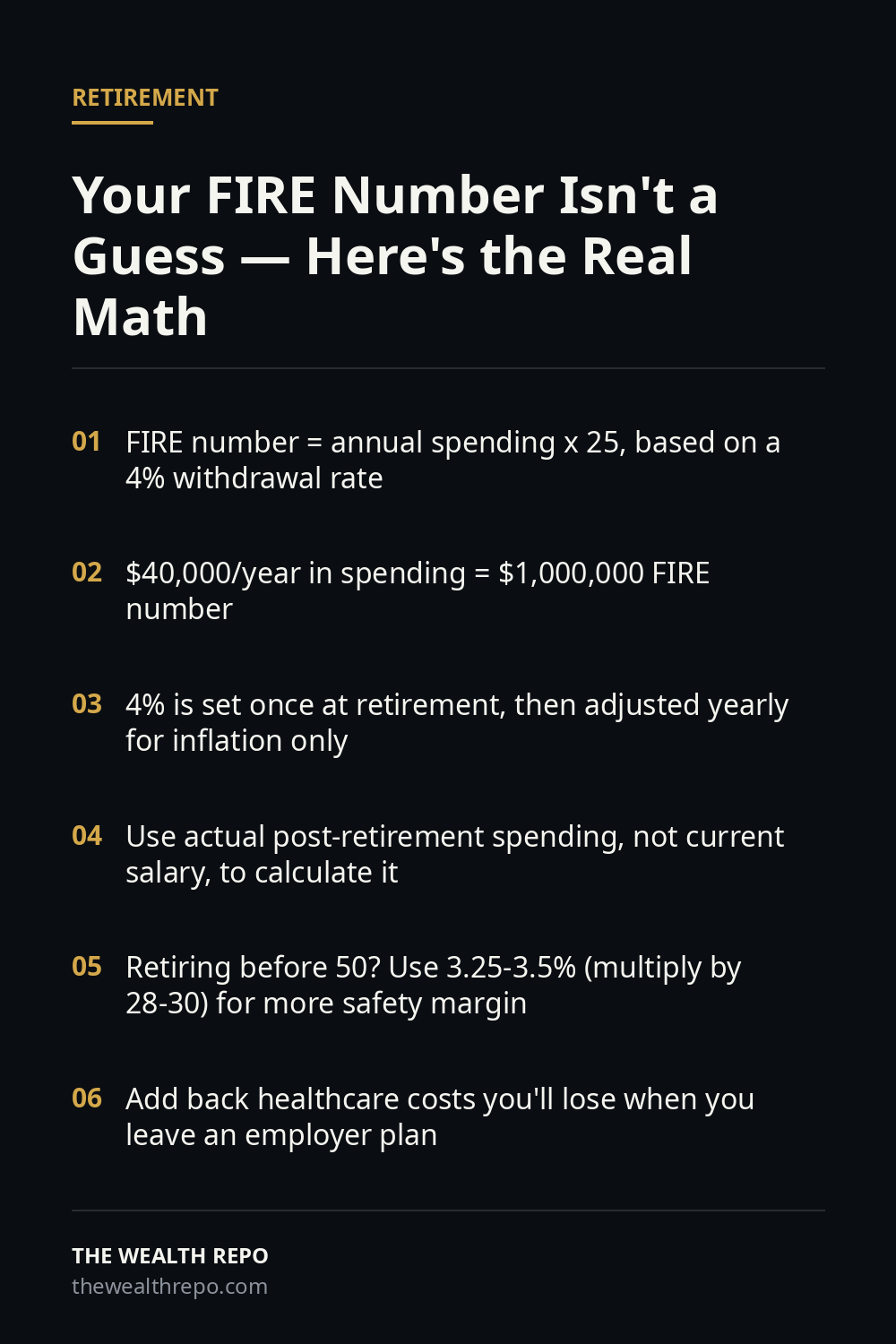
- ✅ FIRE number = annual spending x 25, based on a 4% withdrawal rate
- ✅ $40,000/year in spending = $1,000,000 FIRE number
- ✅ 4% is set once at retirement, then adjusted yearly for inflation only
- ✅ Use actual post-retirement spending, not current salary, to calculate it
- ✅ Retiring before 50? Use 3.25-3.5% (multiply by 28-30) for more safety margin
- ✅ Add back healthcare costs you'll lose when you leave an employer plan

