
Disclosure: Some links on this page are affiliate links. If you sign up through them, The Wealth Repo may earn a commission at no extra cost to you. This is general education, not personalized financial advice.
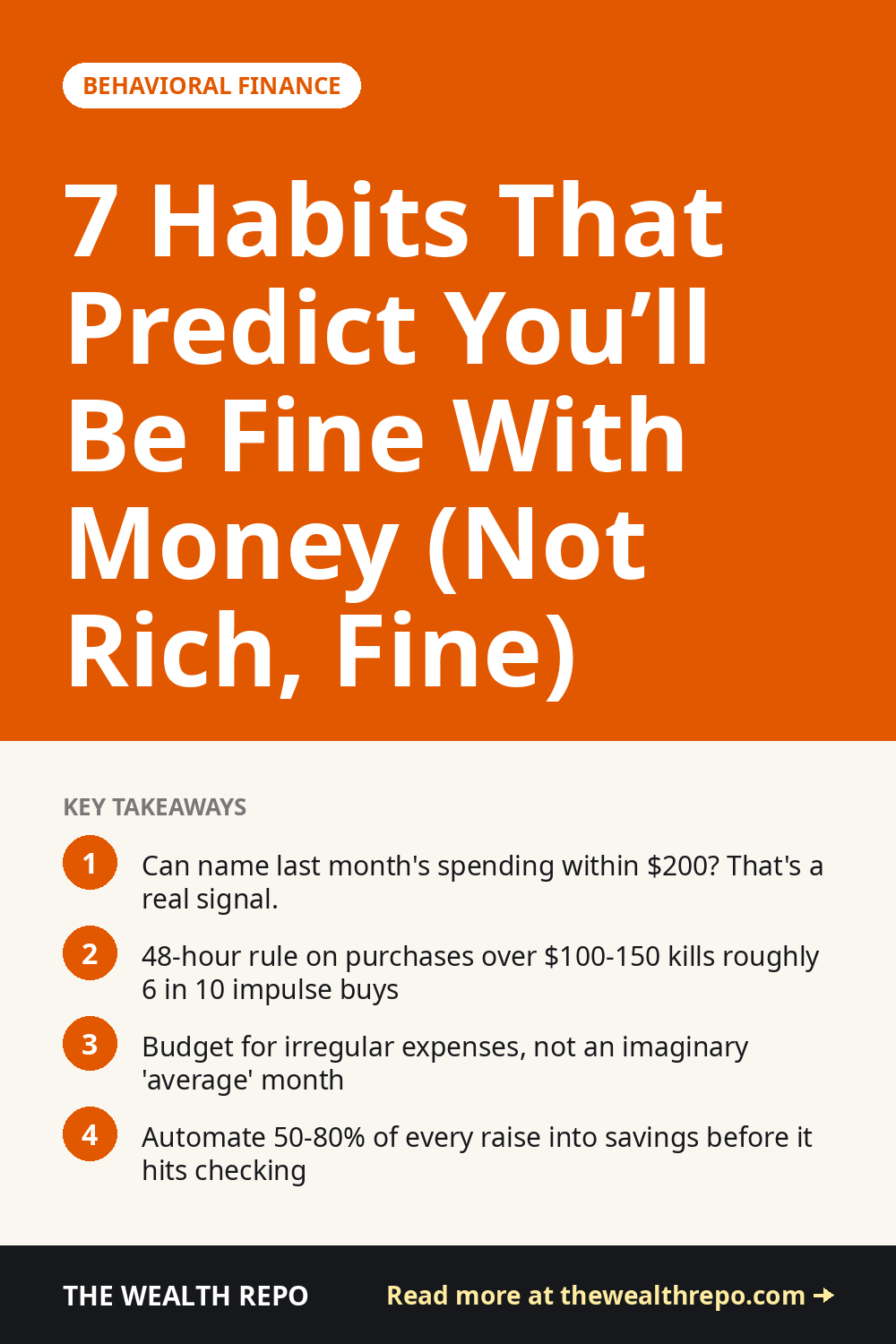
Being good with money has less to do with income and more to do with five boring, repeatable habits. Here's what actually predicts financial health, backed by how the behaviors compound over time.
Forget the idea that being good with money means never buying coffee out or tracking every dollar in a spreadsheet. The real predictor is simpler: do you know your number before the bill arrives? People who are financially healthy can tell you, within a few hundred dollars, what they spent last month and what's coming due this month. That's not discipline, it's just visibility, and visibility is what lets you catch problems at $200 instead of $2,000.
One habit that separates people who build wealth from people who stay stuck is a 48-hour rule on purchases over a set amount, usually $100 to $150. It's not about deprivation. It's about breaking the dopamine loop between seeing something and buying it. Someone who waits two days before buying a $300 jacket will skip it about 60% of the time, not because they decided it was a bad purchase, but because the urge fades on its own. People who buy immediately never get the chance to find that out.
💡 The easiest way to beat spending urges is to move the money first. Robinhood lets you buy stocks and ETFs commission-free, with no account minimum. Open a Robinhood account →
A less obvious sign: good-with-money people treat irregular income as the default, not the exception. Even on a steady paycheck, they build a buffer for the months that won't go as planned, like the car repair, the dentist bill, the friend's wedding three states away. The common mistake is budgeting for an average month that rarely shows up, then treating every slightly-above-average expense as a crisis. A buffer of even one extra month's essential expenses sitting in checking turns 'emergency' spending into 'expected' spending.
The biggest tell, though, is what happens to raises and windfalls. Financially healthy people automatically route 50-80% of any raise or bonus into savings or debt paydown before they ever see it in their checking account, a habit sometimes called lifestyle anchoring. Someone making $60,000 who banks 70% of every $5,000 raise for ten years ends up with a materially different net worth than someone who upgrades their apartment and car every time income ticks up, even if both started in the exact same place.
Key Takeaways
- ✅ Can name last month's spending within $200? That's a real signal.
- ✅ 48-hour rule on purchases over $100-150 kills roughly 6 in 10 impulse buys
- ✅ Budget for irregular expenses, not an imaginary 'average' month
- ✅ Automate 50-80% of every raise into savings before it hits checking
- ✅ One extra month of expenses in checking turns crises into non-events
- ✅ Net worth gap between savers and lifestyle-inflators compounds for a decade

