
A $90,000 salary and a leased G-Wagon can look identical to a $900,000 net worth from the outside, but one person is building equity and the other is renting an image. Here's how spending signals quietly sabotage net worth, and what to track instead.
The math behind 'looking rich' is simpler than people admit: a $75,000-a-year earner can lease a $70,000 SUV for $900 a month, and nobody checking the parking lot knows the difference between that and a paid-off Tesla owned by someone making $200,000. Visible spending is a terrible proxy for wealth because it's financed by income, not built from it. Rolex, rented condo in a doorman building, dinners posted on Instagram — all of it runs through cash flow, and cash flow resets to zero every month. Net worth is the only number that doesn't reset, which is exactly why it's less fun to show off.
The actual mechanism here is opportunity cost compounding against you twice. Say two people earn $90,000. One spends $1,200 a month on a car payment and nice dinners; the other invests that $1,200 in an index fund. After 10 years at a 7% average return, the saver has roughly $207,000 sitting in an account. The spender has a decade of nice dinners and a car worth maybe $8,000 on a good day. The gap isn't just the $1,200 — it's the $1,200 plus everything it would have earned, compounding silently while the other person's purchases depreciated.
The common mistake people make is assuming income and wealth are the same variable. They're not — income is a flow, net worth is a stock, and a high flow with high outflow produces nothing. This is why dentists and doctors making $300,000 a year sometimes retire with less than a schoolteacher who maxed out a 403(b) for 30 years. The teacher never looked rich. She drove a 2009 Corolla for a decade. But she had automatic contributions pulling money out before she ever saw it, while the high earners upgraded their lifestyle every time their income did — a pattern researchers call lifestyle creep, and it's the single biggest reason high salaries don't reliably turn into high net worth.
If you want a quick gut check, do this: add up everything you own (cash, investments, home equity, retirement accounts) and subtract everything you owe. That number is your actual financial position. Then look at your last three months of spending and ask how much of it was visible to other people versus invisible to everyone but you. The ratio tells you whether you're optimizing for looking rich or being rich — and only one of those shows up on a balance sheet in 20 years.
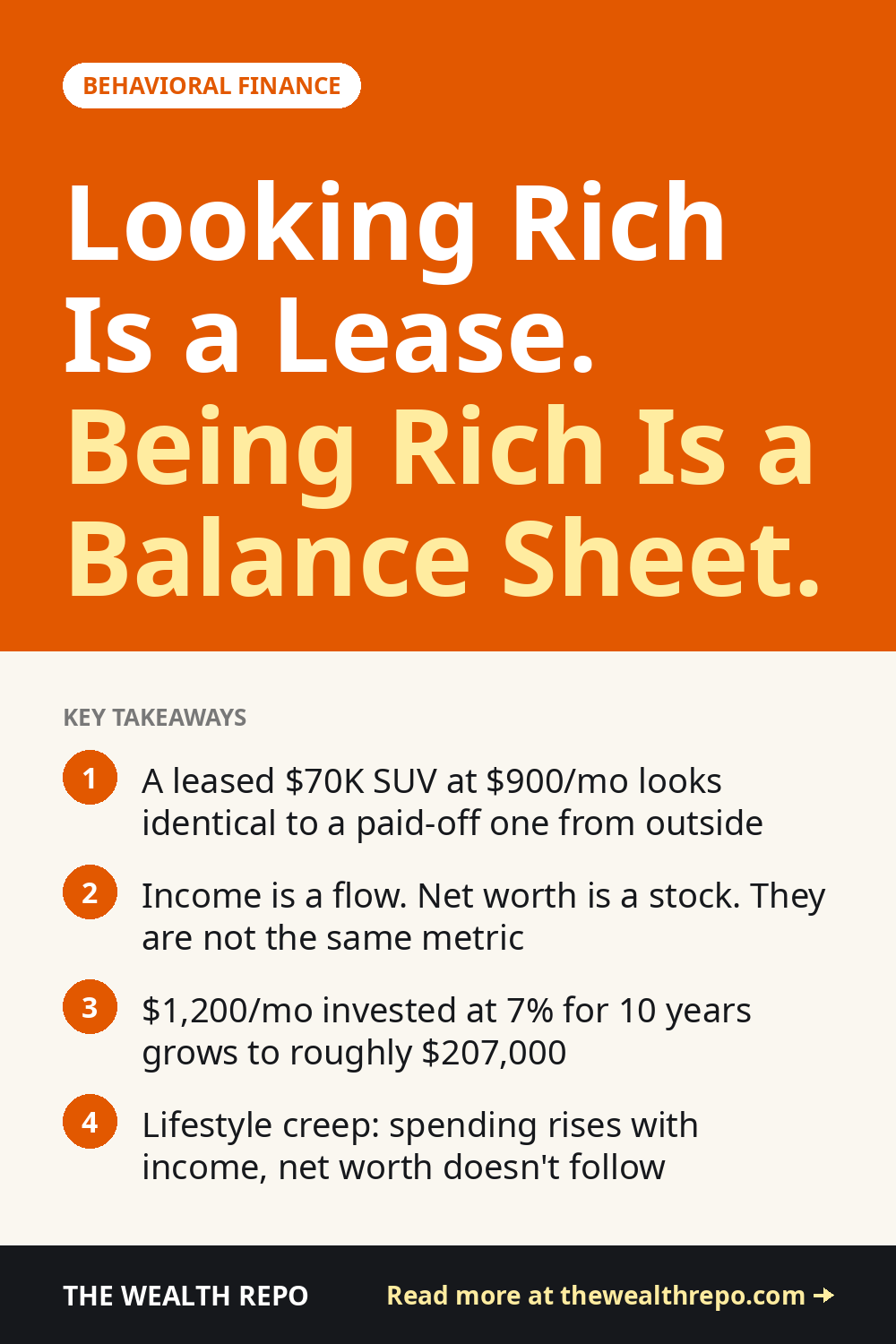
Key Takeaways
- ✅ A leased $70K SUV at $900/mo looks identical to a paid-off one from outside
- ✅ Income is a flow. Net worth is a stock. They are not the same metric
- ✅ $1,200/mo invested at 7% for 10 years grows to roughly $207,000
- ✅ Lifestyle creep: spending rises with income, net worth doesn't follow
- ✅ Visible spending (cars, trips, clothes) is financed by cash flow, not wealth
- ✅ Quick test: assets minus debts equals your real number, not your parking lot

